Sevika Camp In Atlanta
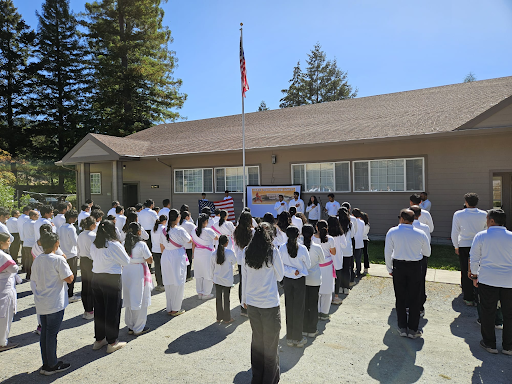
A two day camp was held in Atlanta, GA, from the 24th-26th of July, for sevikas between the ages of ten and thirteen. The camp was organized in memory of Mausiji’s birth centenary, as well to expose sevikas to Hindu Dharma.
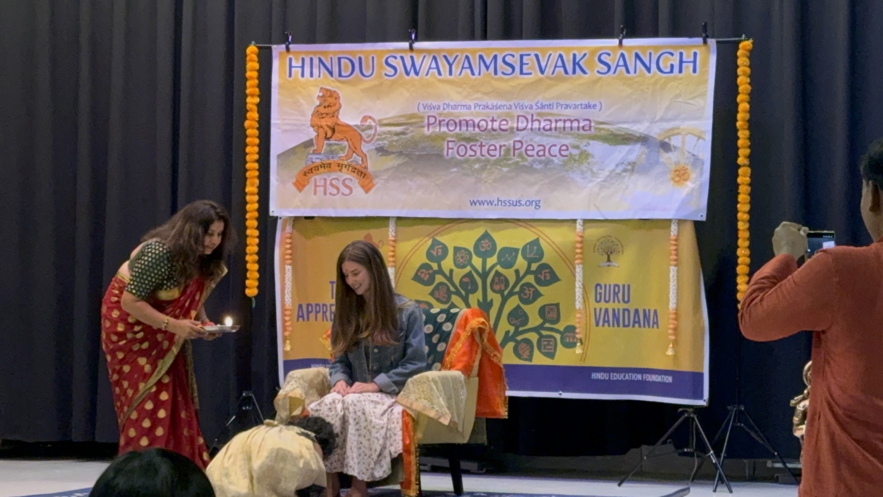
The udghatan of the camp was on the 24th evening, in which the Mukhya Atithi was Sheetal Shah, a member of the Hindu American Foundation. She gave an inspirational speech to the sevikas, and was also very pleased to see such enthusiasm in the youth at a very young age. Parents and various other local members of the Hindu community of Atlanta were present during the inauguration of the camp.
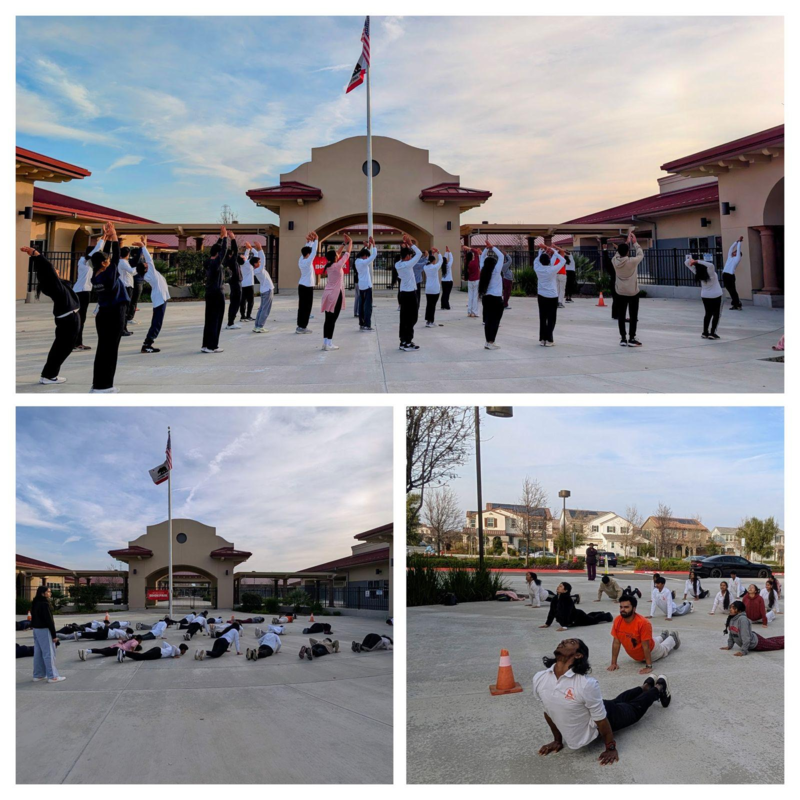
For the next two days, various activities were performed by the sevikas. In the mornings, the day began with yoga and morning shakha, where the sevikas were introduced to different games, niyuddha, danda and pyramids. A few of the sevikas, that attend the Atlanta shakha regularly, prepared interactive presentations on different aspects of Hinduism. For instance, Shilpa Darivemula presented a presentation on the Ten Misconceptions of Hinduism, Nina Appareddy, presented a presentation on the Ten Best Things About Hinduism, while Keerthana presented a presentation called “Tell Me Why,” where answers to certain Hindu customs and rituals were given. A Karyashala was also done, where the sevikas were asked to work on both verbal and non-verbal communication skills. This workshop not only helped in building communication skills but also enhanced team work and cooperation.
During another workshop, the sevikas were divided into four groups, and each group was given a moral, from which they had to prepare skits and present to the rest of the groups. Each was approximately two minutes long, and all the dialogues, illustration, and ideas were prepared by the sevikas themselves. A Vedic Mathematics presentation was conducted by Sandeep Parashar, a Sewa International volunteer, who informed the sevikas of the numerous contributions and strides Hindus have made in the field of mathematics thousands of years ago. The sevikas were especially amazed by the speed through which calculations could be performed. During the Charcha session, the sevikas were divided age wise into smaller groups in order to discuss “How we encounter Hinduism in our daily lives.” The sevikas were divided into three main groups, namely 11 years and younger, 12 year olds, and 13 years and older. This session allowed the sevikas to voice their experiences both at home and elsewhere. This session also made them aware of the importance of certain customs and traditions practiced in Hinduism.
In the evenings, shakha was held, where khel, pyramids and danda were introduced. Shri Shantaka ji gave a Bauddhik on Mausiji and Vedic Women to the sevikas. She touched on the great contributions of Vedic Women such as Maitreyi, Sita, Savitri, and Draupadi. She also elaborated on the contributions and foundation of Mausiji and the Rashtriya Sevika Samiti respectively. A game of Charades and an art session was conducted to bring out their creativity and also to just have fun. During these two sessions, the shikshikas also participated and brought out their own creativity. On the 26th evening, the sevikas presented what they had learned in camp.
During the Samarop, the sevikas presented the khels they had learned as well as the skits, namely “Proud to be a Hindu” and “Think before you act,” in front of their parents. They also presented the Sanghik Geet, “Ish Hame Deta Hai Sab Kuch” which they had practiced during the two days at camp, along with an Amrutvachan, a Subhashit and a Vaiyaktit Geet, “Chalo Jalaaye Deep Vahan” by Keerthana. Shri Shantaka ji also delivered a small Bauddhik encouraging parents to be involved in Hindu activities, and emphasizing the need to keep the Hindu identity alive for the generations to come. The Mukhya Atithi for the Samarop was Dr. Poorna, who was very delighted to see the activities done at the camp, and for the Hindu cause. The Samarop lasted an hour, after which the parents were invited to have Bhojan, which was kindly prepared by the Hindu Temple Of Atlanta.
HSS Announces 18th Annual “Health for Humanity” Yogathon
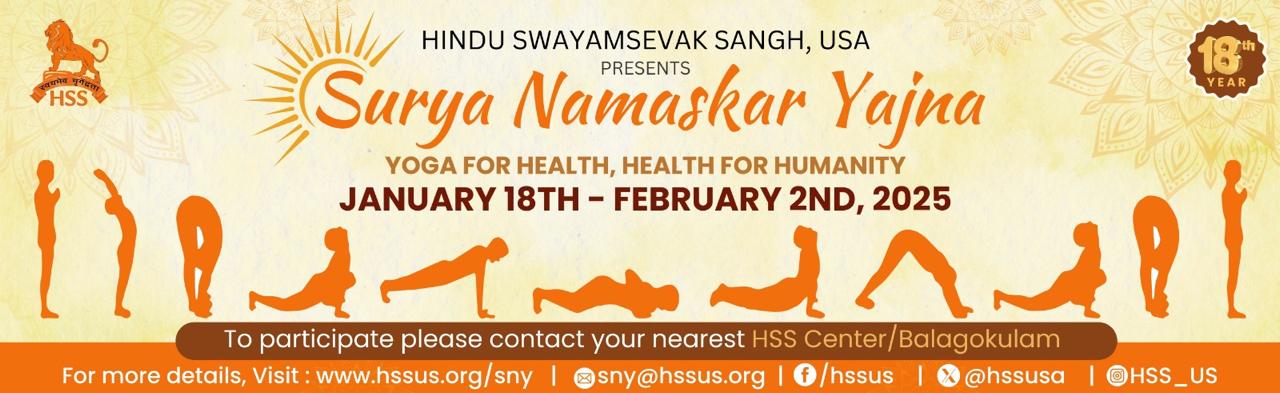
Hindu Swayamsevak Sangh (HSS) announces the seventeenth annual “Yoga for Health, Health for Humanity Yogathon” or “Surya Namaskar Yajna” (SNY). This program runs from January 18th to February 2nd, 2025. Participants across all ages, genders, races, ethnicities, nationalities, and faiths are invited to participate in the Yogathon to kickstart the New Year with health awareness and practice.
Surya Namaskar is a yogic practice done in reverence to the sun. Research shows several physiological and psychological benefits from Surya Namaskar when practiced regularly. They are performed as a series of 10 physical postures, flowing in a graceful, continuous sequence. The Surya Namaskar Yajna seeks to promote the practice and its benefits among all Americans aspiring for a fit body and balanced mind.
Since its inception in 2007, participants from 43 states have actively participated in the Yogathon through Yoga centers, community organizations, schools, and colleges, and also as individuals. Regardless of their faith and belief, these participants have performed over four million Surya Namaskars over the past several years. This is a testament to the success of the Yogathon in achieving diversity and inclusion in communities nationwide while promoting public health and well-being equitably.

Acknowledging this, community leaders and elected officials across the nation also appreciate this initiative and encourage their residents to participate in the Health for Humanity Yogathon and benefit from a healthy lifestyle. The Yogathon has received numerous proclamations from American mayors, governors, US Congressmen, and US Senators. It also found recognition in the Congressional records in 2017. The “Let’s Move” initiative of then First Lady Michelle Obama declared HSS as a partner in 2012 in cognizance of the Yogathon.
About Hindu Swayamsevak Sangh (HSS):
HSS is a 501(c)(3) voluntary non-profit cultural organization with over 230 chapters across the United States. HSS organizes service activities and community outreach projects to promote discipline, self-confidence, teamwork, and the spirit of selflessness. HSS also fosters a dynamic and flourishing Hindu-American community through civic duty, responsibility, and volunteerism, instilling lasting pride in Hindu heritage among its members. Learn more at www.HSSUS.org.
HSS Announces 18th Annual “Health for Humanity” Yogathon
.jpeg)
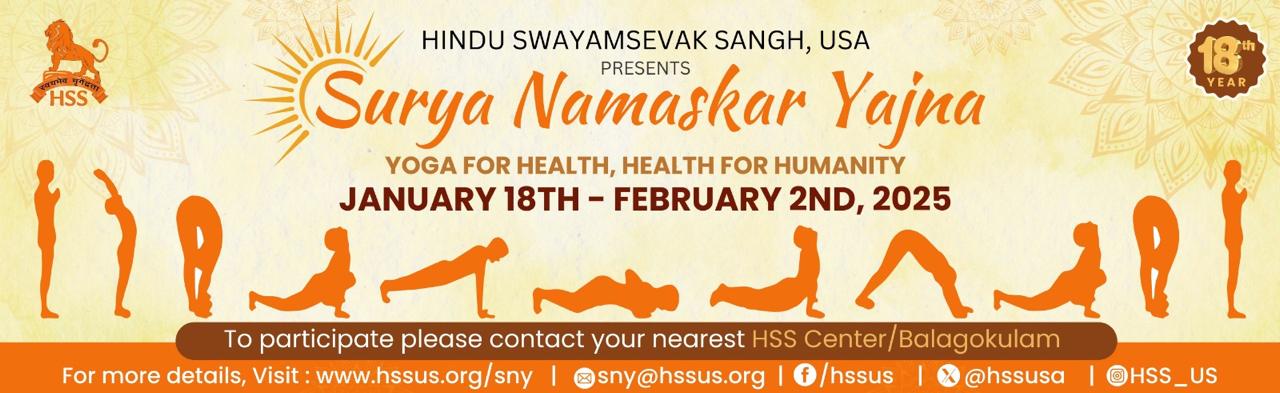
Hindu Swayamsevak Sangh (HSS) announces the seventeenth annual “Yoga for Health, Health for Humanity Yogathon” or “Surya Namaskar Yajna” (SNY). This program runs from January 18th to February 2nd, 2025. Participants across all ages, genders, races, ethnicities, nationalities, and faiths are invited to participate in the Yogathon to kickstart the New Year with health awareness and practice.
Surya Namaskar is a yogic practice done in reverence to the sun. Research shows several physiological and psychological benefits from Surya Namaskar when practiced regularly. They are performed as a series of 10 physical postures, flowing in a graceful, continuous sequence. The Surya Namaskar Yajna seeks to promote the practice and its benefits among all Americans aspiring for a fit body and balanced mind.
Since its inception in 2007, participants from 43 states have actively participated in the Yogathon through Yoga centers, community organizations, schools, and colleges, and also as individuals. Regardless of their faith and belief, these participants have performed over four million Surya Namaskars over the past several years. This is a testament to the success of the Yogathon in achieving diversity and inclusion in communities nationwide while promoting public health and well-being equitably.
Acknowledging this, community leaders and elected officials across the nation also appreciate this initiative and encourage their residents to participate in the Health for Humanity Yogathon and benefit from a healthy lifestyle. The Yogathon has received numerous proclamations from American mayors, governors, US Congressmen, and US Senators. It also found recognition in the Congressional records in 2017. The “Let’s Move” initiative of then First Lady Michelle Obama declared HSS as a partner in 2012 in cognizance of the Yogathon.
About Hindu Swayamsevak Sangh (HSS):
HSS is a 501(c)(3) voluntary non-profit cultural organization with over 230 chapters across the United States. HSS organizes service activities and community outreach projects to promote discipline, self-confidence, teamwork, and the spirit of selflessness. HSS also fosters a dynamic and flourishing Hindu-American community through civic duty, responsibility, and volunteerism, instilling lasting pride in Hindu heritage among its members. Learn more at www.HSSUS.org
HSS’s Formal response to Georgetown University-Bridge Initiative's so-called Factsheet
Hindu Swayamsevak Sangh USA (HSS) has conveyed our following content in a formal email sent to the President and Vice President/Chief of Staff of Georgetown University. Unfortunately, they didn’t acknowledge it or responded to a subsequent follow up, despite concerns expressed about misinformation published about a reputed organization that represents American Hindus on Georgetown University website,
We are writing to bring to your attention the falsified material presented, and inferences drawn in the Factsheet about the Hindu Swayamsevak Sangh USA (HSS) available on Bridge Initiative’s webpage hosted by Georgetown University's website.
Hindu Swayamsevak Sangh USA (HSS) operates as a legally constituted, independent, 501(c)(3) non-profit organization in the United States, adhering strictly to the nation's laws and confining its activities solely within the country. It has achieved a rating of 92% by CharityNavigator.org for financial health, which encompasses efficiency, sustainability, and trustworthiness, along with a strong commitment to governance practices and policies.
We are appalled that the factsheet about HSS lacks basic research and fosters animosity towards the minority Hindu community in the United States. It deviates from established standards of academic research and professionalism, despite using the university’s academic resources. Below is a list of deviations, misrepresentations, and inaccuracies that we wish to especially highlight -
- The factsheet’s ‘Impact’ section does not state HSS’ connection to Islamophobia in the US or anywhere around the world. It also fails to link HSS’ social activities, programs, and teachings with Islamophobia anywhere.
- The factsheet claims to be authored by the "Bridge Initiative Team," yet the hyperlink doesn’t publish any name of the author and leads to an error page stating, "Oops! That page can’t be found."
- Also, an individual named Raqib Naik, mentioned as the collaborator, claims to be the author of this “report” on his X account. This same person’s X account shows Hinduphobic tweets over the years. From his previous articles and tweets, he appears to be an extremist, nurturing venomous hate towards Hindus.
- The reference to the Hindu Education Foundation (HEF) in the factsheet as suggesting that Islam is inherently violent is a misleading representation. In reality, the HEF proposed a change about Mughal rulers, as stated in the article. Unfortunately, the authors of the factsheet chose to interpret historical injustices solely through a religious lens, thereby stigmatizing all Muslims.
- The factsheet states, In an April 2023 piece for The Nation, a former participant from Boston, who attended Balagokulam in 2004 and 2005 when she was 11 years old, stated they left the program due to its Hindu nationalist curriculum. The article cited here does not mention that the “Hindu nationalist curriculum” drove away the family from the Balagokulam. Hence, this statement in the factsheet is a blatant lie. This referenced article also goes to the extent of ridiculing Yoga and other Hindu practices, and is, therefore, incredibly Hinduphobic.
Hence, we see this factsheet as a smear campaign against HSS’ law-abiding, rightful activities and consequently, an injustice to the minority Hindu community’s freedoms. It is disheartening that the Georgetown University administration allows the use of its official website and labels “the Bridge” as its initiative, but remains largely unaware of such activities, which poses a serious concern in the current climate characterized by the proliferation of hate-driven agendas with political motives. This situation imperils the safety and well-being of the targeted community, notably Hindu students at Georgetown University and the broader minority Hindu community.
We are proud of our continuous contribution to the American Society. As an American non-profit, HSS actively embodies a philosophy rooted in respect for all individuals, irrespective of their race, gender, faith, age, nationality, or ethnicity. Our partnership with Interfaith organizations is much appreciated. Our initiatives supported charity organizations in over 200 cities to reduce food insecurities. For the past 17 years, we reached out all across the US to bring health awareness through our Yoga for Health, Health for Humanity Program. Our contributions, extensively covered in the media, have been lauded by numerous stakeholders, including first responders, law enforcement officers, charitable organizations such as food banks, school administrators, professionals, entrepreneurs, and lawmakers across the nation. Our commitment lies in advancing societal well-being rather than embracing a victimhood narrative driven by self-interest.
We urge you to review the contents and institute safeguards to prevent abuse of the Bridge Initiative platforms in harassing, defaming, and intimidating the minority Hindu community in the US and their institutions.
HSS Announces 17th Annual “Health for Humanity” Yogathon
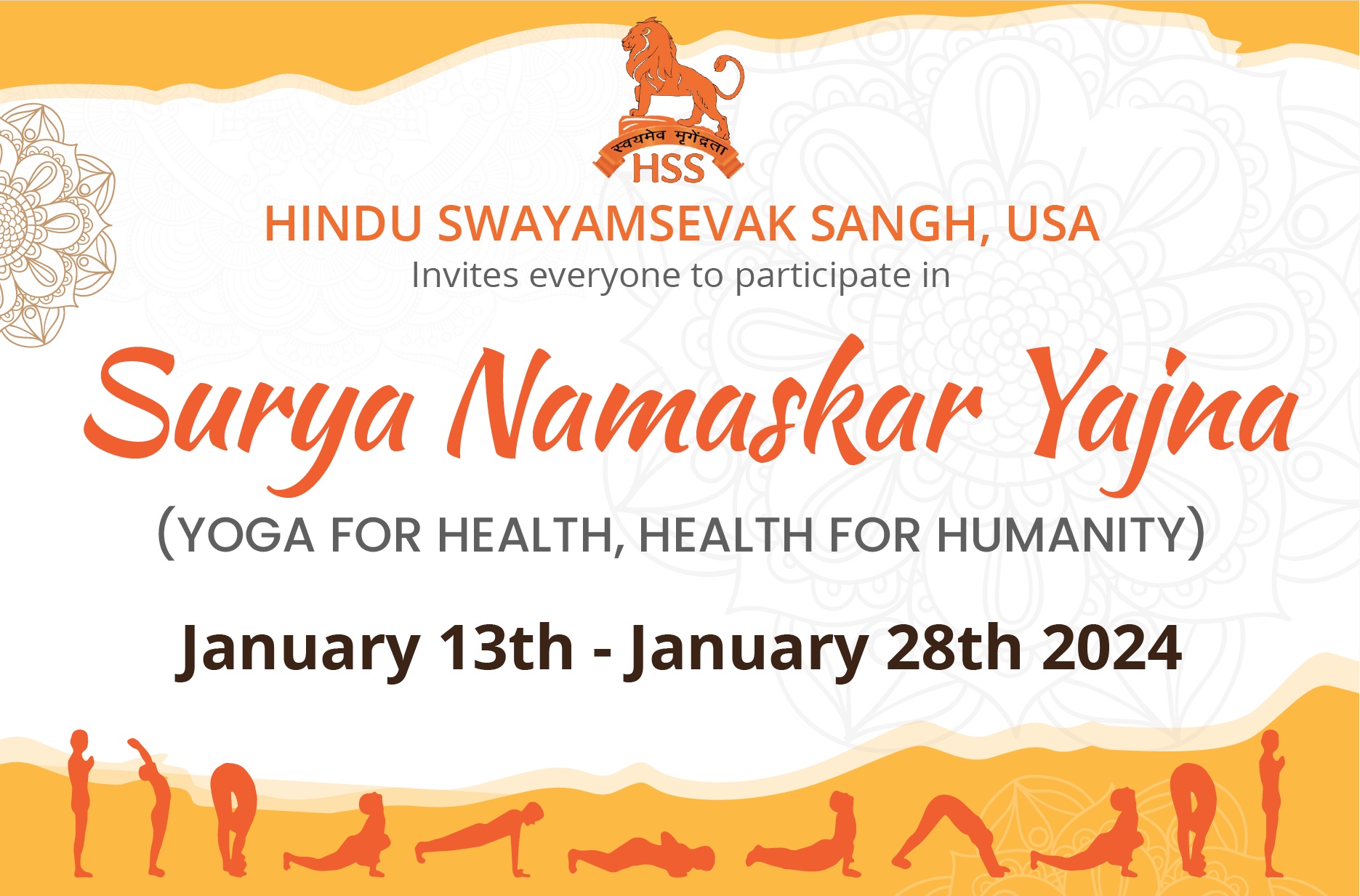
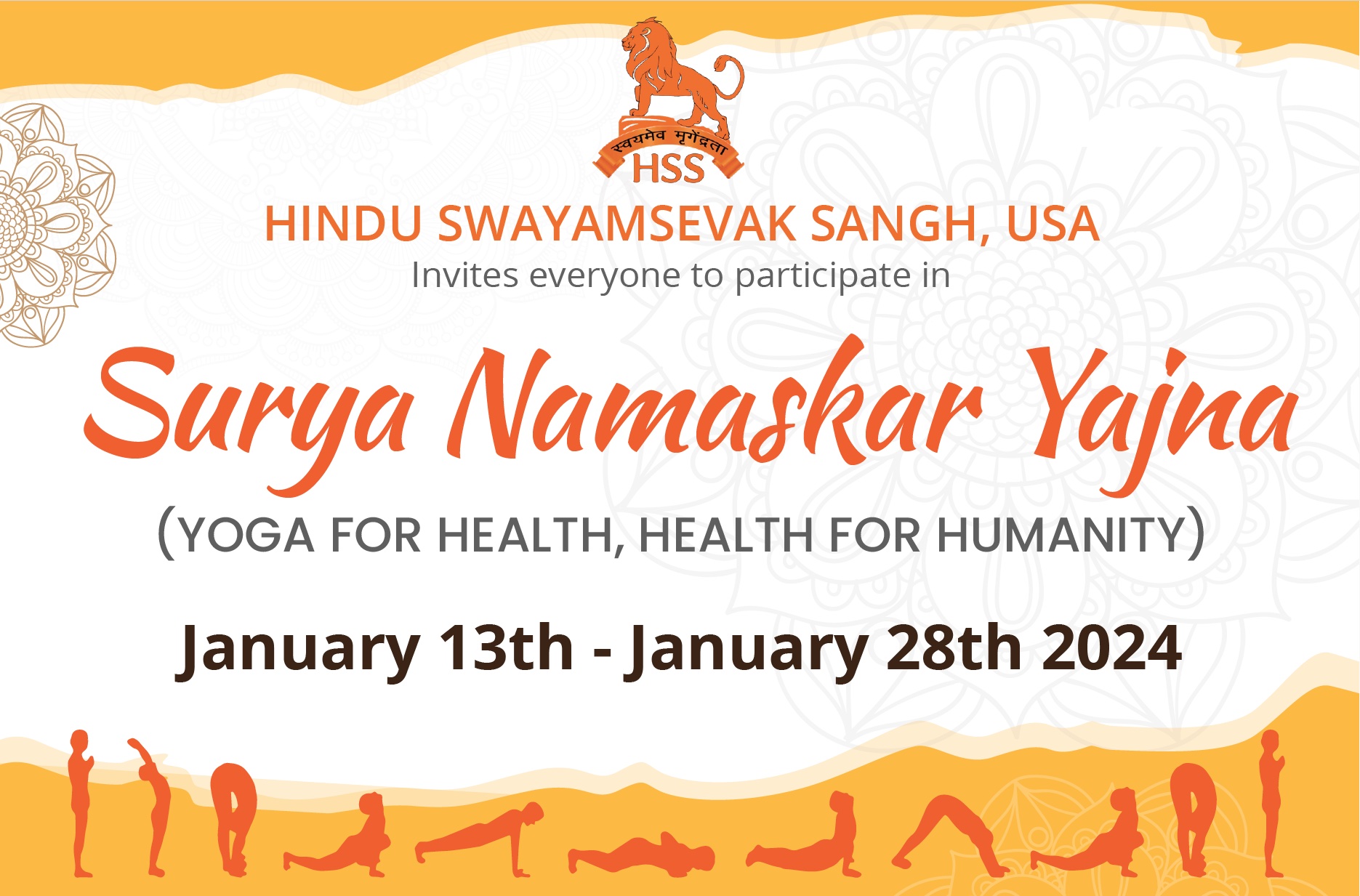
Hindu Swayamsevak Sangh (HSS) announces the seventeenth annual “Yoga for Health, Health for Humanity Yogathon” or “Surya Namaskar Yajna” (SNY). This program runs from January 13th to January 28th, 2024. Participants across all ages, genders, races, ethnicities, nationalities, and faiths are invited to participate in the Yogathon to kickstart the New Year with health awareness and practice.
Surya Namaskar is a yogic practice done in reverence to the sun. Research shows several physiological and psychological benefits from Surya Namaskar when practiced regularly. They are performed as a series of 10 physical postures, flowing in a graceful, continuous sequence. The Surya Namaskar Yajna seeks to promote the practice and its benefits among all Americans aspiring for a fit body and balanced mind.
Since its inception in 2007, participants from 43 states have actively participated in the Yogathon through Yoga centers, community organizations, schools, and colleges, and also as individuals. Regardless of their faith and belief, these participants have performed over four million Surya Namaskars over the past several years. This is a testament to the success of the Yogathon in achieving diversity and inclusion in communities nationwide while promoting public health and well-being equitably.
Acknowledging this, community leaders and elected officials across the nation also appreciate this initiative and encourage their residents to participate in the Health for Humanity Yogathon and benefit from a healthy lifestyle. The Yogathon has received numerous proclamations from American mayors, governors, US Congressmen, and US Senators. It also found recognition in the Congressional records in 2017. The “Let’s Move” initiative of then First Lady Michelle Obama declared HSS as a partner in 2012 in cognizance of the Yogathon.
About Hindu Swayamsevak Sangh (HSS):
HSS is a 501(c)(3) voluntary non-profit cultural organization with over 230 chapters across the United States. HSS organizes service activities and community outreach projects to promote discipline, self-confidence, teamwork, and the spirit of selflessness. HSS also fosters a dynamic and flourishing Hindu-American community through civic duty, responsibility, and volunteerism, instilling lasting pride in Hindu heritage among its members. Learn more at www.HSSUS.org.
HSS mourns passing of Prof. Ved Nanda
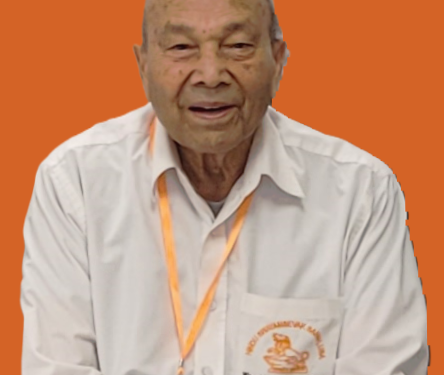
HSS mourns the passing of its America Sanghachalak (President) Prof. Ved Prakash Nanda on Monday, January 1st, 2024 in his hometown Denver, CO. He was surrounded by his close family and HSS volunteers.
Born in 1934 in Gujranwala of the undivided India, Prof. Nanda underwent an arduous immigration to the Punjab state in India along with his family during the partition of Pakistan from India. He went on to build an exemplary career starting from M.A. Economics from Punjab University, Law degree from Delhi University in India, and LLM from Northwestern University and subsequent postgraduate work from Yale University in the US. He was a champion of Human Rights and a successful International Law professor at the University of Denver Denver’s Sturm College of Law since 1972. He was also Honorary President of the World Jurist Association, former honorary Vice President of the American Society of International Law, and a member of the advisory council of the United States Institute of Human Rights. He was widely published, having authored or co-authored 24 books in various fields of international law. He was a regular columnist for the Denver Post and wrote on a wide range of topics including human rights and international relations. In 2006, the University of Denver Denver’s Sturm College of Law alumni founded the Ved Nanda Center for International and Comparative Law in his honor. He has also received a number of awards including the Gandhi-King-Ikeda Award for Community Peace Building in 2004 and the Padma Bhushan in 2018 by the Government of India.
The cause of preserving Hindu Dharma and integrating Hindus in America was dear to Prof. Nanda and he advocated it lifelong with his infectious smile, humor, and compassion. He started the first shakha in the US in 1961 at the University of Chicago. Since 2001, after becoming president of HSS, Prof. Nanda constantly traveled across the country to meet, guide, and inspire HSS volunteers. He took initiative to reach out to the opinion makers of the society for various Hindu-American causes.
He also served as the Chairman of the Board of Hindu University of America. He was the chairman of the board of trustees at Hindu Temple of Colorado and also remained active in interfaith activities in Colorado.
He leaves behind his daughter, Anjali, son-in-law, granddaughters and extended family. On the demise of our beloved Nanda ji, we express our heartfelt condolences to his family and acquaintances and pray to the Almighty that the departed Atma be absorbed in the Divine light.